
Two Years Aged Out
A Branch in the Wind

I got a job at a nursing home. A three-winged single-floored facility on a tree-lined boulevard. Filled out their simple application, talked briefly with the head nurse, a middle-aged woman named Tate, and had the job that very afternoon—and a roommate too. I moved in with my former suitemate turned night shift co-worker, a Wyoming girl named Linda whose daddy put her up in a duplex apartment down the street from work and a convenient half a mile from the university we both attended.
Six nights a week, eleven p.m. to seven a.m., wearing a pair of discount hiking boots and a 1940’s nurse’s uniform I’d found at a local thrift store, I walked the dark halls of the nursing home with a flashlight taking care of the elderly. Checking for breath among the bedridden, dispensing bedpans, changing adult diapers, crushing pills in applesauce, and monitoring the pulses of Leticia and Faye, Sarah Jane, Esther, Mr. and Mrs. BW Parker, and tiny Tillie Anthony.
I loved working with the ancients. Learned more from them than I ever did in school. Sure, I was young, and they were not, but like me they were in transition, aging out of one realm and into another. It made sense to care for them, to watch lest they fell, to tend to them night after night. When they rang the emergency bell I ran, listened to their secrets, savored their confidences, and became what I had never been to any living soul—indispensable. When they asked, alone and trembling, if I’d be their little girl, their darling girl, I said yes without hesitation.
Still nothing was mine and mine alone, to grab hold, to depend on, to adore.
I lived between work and school, a detached fragment outside the bonds of polite society—a lonely stray only at peace in a notebook or the dark halls of the nursing home.
And then I met him.
I should have known better. I’d been warned enough what could happen to someone like me—a foster girl, recently aged out of the dependency system, taking art classes at the only college I could afford, a girl without a safety net, living moment to moment, in appearance an adult, in reality a child. I should have asked for help. But no one there knew where I came from, and I wanted to keep it that way. Still, I should have been more cautious.
You should, you should, you should.
No one ever tells you what you have to go through to get what you want or who you might become as a consequence.
I met him in the drawing room at school. Walked in one Sunday afternoon expecting solitude and found instead a gorgeous Kiowa man standing in front of an eight-foot-high self-portrait, profile of a fierce brave, a vertical mountain of a man painted in primaries. Hair streaming, a vivid, blue-nosed wolf as headdress. Clothing a combination of Sergeant Pepper sixties and turn-of-the-century dandy. The composition a mix of tribal and fauve, with a border of primordial circles within circles.
“I don’t know what to name it yet,” he said, not bothering to turn around.
“His hair flows like a river,” I answered because it did.
“That’s the name all right,” he said and pivoted on a cowboy boot heel to face me.
I didn’t ask who he was. I already knew. He was Tommy Wayne Cannon, aka TC, like me a student at Central State University, unlike me, newly back from Vietnam, and at twenty-seven, already a successful poet/painter.
He said he’d give me a lift home and led me outside to his canary yellow convertible parked in a no parking zone, the top down in defiance of the season.
“Don’t you love this crazy weather?” he asked.
Tornado season—just after winter’s thaw, before summer’s splintering wind, polar air collided with hotter stuff up from the Gulf and dropped down from the heavens into the flat middle of America spinning whatever it hit all to hell.
I slid in beside him. But he didn’t take me to the duplex I shared with my work mate Linda; instead, he took me to his place, a woodsy condo on the edge of town. Loaded the stereo with a stack of records, Dylan, and some corny country stuff, and let me wait while he took a phone call from an important collector.
They talked a long time. Long enough for me to nose around.
In the living room there was nothing but a stereo, giant speakers, a pole lamp, and some floor pillows—in the kitchen an avocado green refrigerator was stocked with Twinkies and Coors. The cupboards were almost empty too, except for a package of chocolate cupcakes and eight bottles of Wild Turkey. In the hallway I found stacks of stretched canvases leaning against the walls, striking displays of Indians in the not so long ago, and the current everyday: a lone man on a horse, a group of women cutting meat. I flipped through them taking note of his motifs—circles—limitless, celestial, and endless—framed brave men and bare-breasted women whether indoors or out.
Upstairs, drawings papered the walls of his bedroom turned studio: pen and ink, lead pencil, felt tip pen, made in all kinds of ways, cartoons, simple contours and full on rendered. I zeroed in on a sketch of a pregnant woman on a horse, grimacing, sun in her eye, body a purple shadow on a golden Van Gogh ground. Thumb tacked beside it were newspaper photos of bomb explosions and the aftermaths of massacre—current and historical—Wounded Knee, Dresden, Nagasaki, and My Lai, collages of black helicopters and portraits of disgraced leaders, Nixon beside Custer. An easel stood sentinel in the middle of the room; black plastic rolled out under it protecting the orange shag carpet. Books were all over the floor; a stool sized stack of them held his palette. In the adjacent bathroom a Matisse portfolio laid open on the floor by the toilet displayed a mint green Fauve woman in flimsy purple clothes. On the sink edge an uncapped toothpaste tube sat beside a stale beer.
A song I liked started to play on the stereo, one about a girl artist who never looks back, so I returned to the sparsely furnished living room and found TC sitting on a floor pillow in front of a stereo speaker, smoking and staring at the ceiling. I plopped down beside him and became unusually talkative and questioning. “You live here all by yourself. Aren’t you ever lonely?”
“All I want is to be in the history books,” he answered. “Everything else is irrelevant.”
To be in the canon was all that mattered to him.
After that proclamation he snubbed out his doobie, took my face in his soft hands, and kissed away any other questions.
Kissed until the song was over, needle sliding back and forth on the black edge of a spinning disc, persistent as his hard-on pushing against my flat belly. I heard him unzip. Unbuckle his belt. Felt him push my cut-offs down, and then me down too. Dragged me over synthetic shag into place under him. Rug-burned thighs sent a jolt of adrenaline up my spine as he hooked my legs over his thick shoulders and pinned me down. Hovered over and above me like a knowing animal, like a philosopher king, like everything I wanted to be. And I just watched. Watched his moves. From someplace else I watched. He moaned but I remained in place, watching and wondering, as quiet as a girl should be.
A girl who floated through town in fringed suede boots, cut off Levi’s, and halter-tops made from thrift-store scarves, who loved Tang, salty food, the smell of old sweatshirt jackets, and the look of dead winter trees against the horizon. A girl who concentrated on being smart, on getting by, not on being a girl, a girl who lived in her Big Chief notebooks, in sixty perfect wide-ruled sheets, each a generous eight by twelve. I carried them with me in a nylon backpack, black and bulging, zippers strained by additions beyond its capacity: of notebooks, writing pencils and erasers, old sketches, and vague dreams. Whatever came into my head, clichéd or corny, scary, or strange, things you were supposed to keep to yourself—I put in my notebook. Ever since a small child I’d been a mark maker, turning nothing into something, the jumble of life into a line, then a circle, then a letter, then a full-on sentence. Make it up, just make it up—put it on the page, the blank page of possibility. Decide to be beautiful and wanted and strong and you will be. I drew and I wrote day after day. Still, I never felt safe, never knew enough. Never wore make-up and never went home on school breaks.
Home was some place in the future.
“Hey,” TC said, and stopped. Zipped up his fly. Buckled his belt. “You’re afraid,” he said. “Really afraid. How about we just listen to the music for a while.”
And we did. We sat side-by-side on the floor of his living room listening to the flip side of his new Willie Nelson LP.
“Smile,” TC said. “When you smile you’re gorgeous.”
I smiled and relaxed enough to finish listening to his favorite album.
Then he took me back to the duplex.
All the way there I pictured how I must look to him. Willing, yet conflicted, admiring his work, but resisting his moves. A pretty enough girl with the intense face of someone who would pursue what she wanted no matter the end. When he turned off his motor in front of my place, I told him I’d make him lunch if he wanted to come in. Sang a little song to myself as he followed me up the front steps, even made a hula move through my front door, hopeful, and light, trying to stop watching myself, to just melt into being watched by him.
Relieved my roommate wasn’t home, I fixed tuna fish sandwiches and mixed up a pitcher of cherry Kool-Aid, and TC and I sat across from each other at the redwood picnic table Linda and I had hauled in from the backyard—the only furniture in the place besides our beds, mattresses on the floor, Linda’s in the official bedroom, mine in an alcove by the back door.
“Sorry, I don’t have any beer or Twinkies.”
“What are these?”
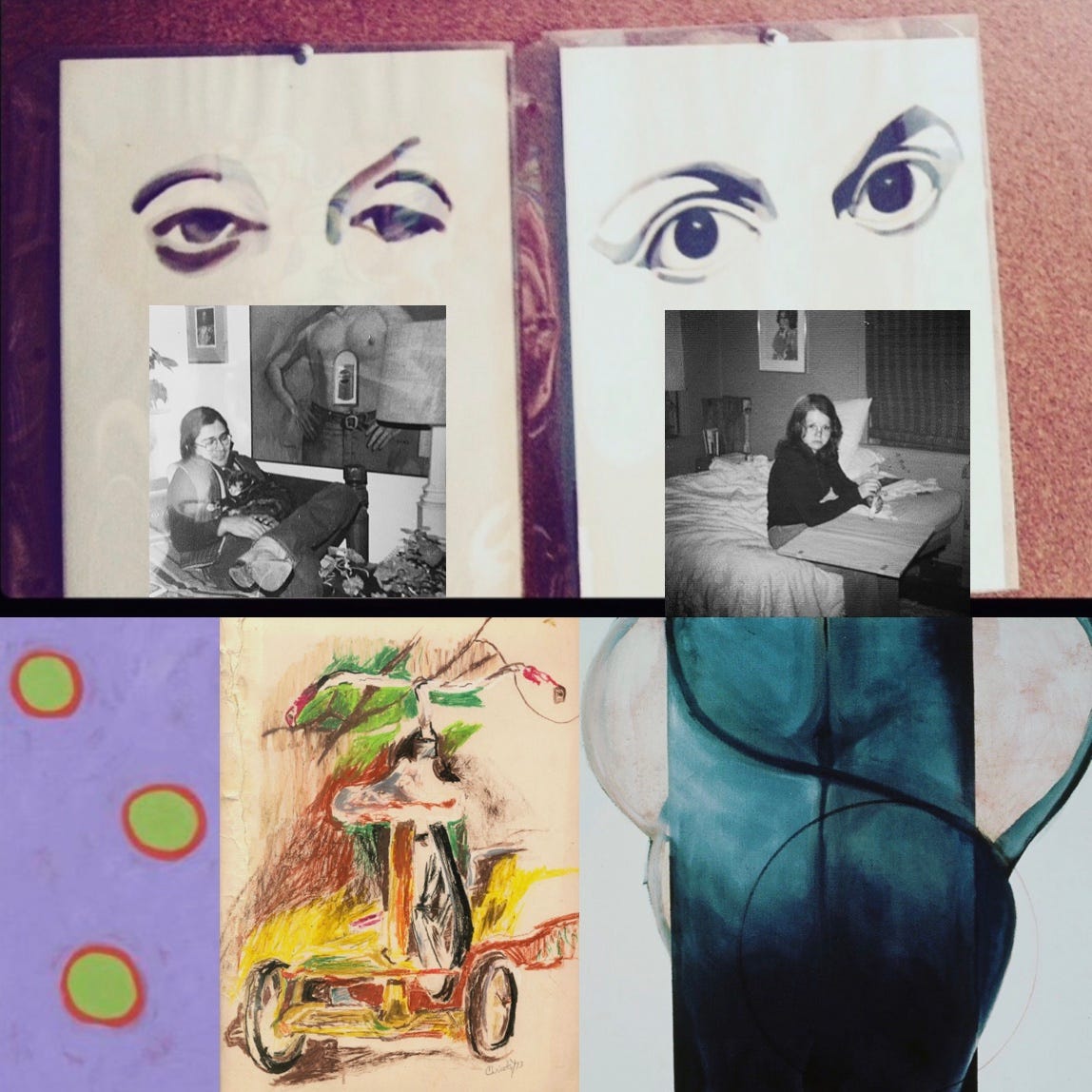
Before I could stop him, he had flipped opened my Wide Ruled Big Chief to a sketch I’d made a few weeks before—a colorful, waxy brevity. A kid’s tricycle, left in the yard across the street by a family who had moved suddenly. Just threw the trike beside boxes of trash and left. I’d watched them take off. Heard their kid cry. Walked over to see what was going on and stayed to record what they’d abandoned.
Draw every day, that’s what art students were told. Draw all the time, in your head and on the page. Start with what stays put, and move on to everything else, the in between, the positive and the negative space, the real and the imaginary—dragging lead across a blank page I did just that. What properly belonged in a book, on a wall, to a life span, I didn’t know. But I was searching for it. Listening to teachers by day and the ancient ones by night. Looking for “my people.” Alert to the uncanny combination of familiar and complete surprise that allows you to say to yourself, this is mine, meant for me, stick around, pay attention, overlook the possible dangers—ignore risk, and follow your often-faulty instincts to their natural conclusions.
“You should do these big,” TC said. “I mean it. Really big, get it out there, out of your notebook, out of your head. Out there in the world.”
His paintings looked large no matter their dimensions. Everything on the picture plane flattened, yet not fully abstracted—realistic and hyper-designed. Simplified. To do this, he said, you need psychic and physical distance from what you’re looking at and what you’re thinking about.
You need to take a true measure of yourself.
Step back with honest eyes for a good perspective.
See the you that others see.
That was what I was trying to do. But that isn’t what I told him. “Right,” I said, because I was overpowered by doubt.
“Do you want to be an artist?” he asked. “Is that what you really want?”
Pinned on the wall behind me were cutouts and postcards, reproductions of images I’d only ever seen in reproduction, in bookplates, or projected from slide carousels in dark classrooms. Nude girls on a riverbank, a dainty teacup lined with animal fur, a woman’s face fractured by cartoon tears, a gray grid, a splash of crimson goop, a black and white night imploded. Serious art from serious people—inspired. What I hoped one day to make. One magic day I hoped I’d look in just the right way, and my heart and head would connect, become one body, whole and united, and I’d make something honestly and only my own.
But I wasn’t there yet.
“What do you want?” TC asked again.
“To be some kind of a writer or an artist.”
“Keep doing all of this. And change your name.”
“What?”
“To CJ. Sounds better. More serious.”
More like a man.
“But I’m a girl.”
He laughed. “I’m telling you. Keep doing this.” He drew one of his circles around my notebooks, our conversation, and the day. “And you’ll be a woman.”
He made that proclamation, and then he took me by the hand and led me to the mattress on the floor by the back door to try making it one more time.
He liked my butter-soft young skin; I liked how all his paintings had circles in them. Did I love him? I didn’t know. I was drawn to him. To his looks, his ambition, his desire of me. Sure, he was a turn on: beautiful and smart, caramel skin, blue-black hair, full lips, and deep brown eyes. I wanted him to want me. But more than that, I wanted to be him. I thought if he put his well-proportioned hands on me, I would miraculously know how to live my own life. So, I pulled back the madras print of my halter-top, undid the buttons on my cutoffs, and let him in.
Afterwards, I watched him doze, aware I knew nothing more about him than I had earlier in the day at his apartment, listening to his music, looking at his paintings, and checking out the contents of his refrigerator.
I stared so long he opened his eyes. “Don’t worry,” he said. “I pulled out.”
Then he went at it again.
It was late afternoon before he left.
At the door he grabbed me around the waist and coaxed a sway from my foster girl reserve.
“What’s up with you?” he said. “I feel like the wagons have circled to keep me out and I’m riding ‘round and ‘round searching for a way in.”
I told him I couldn’t afford to be late to work again. I was always late.
He laughed. Twisted the ring off his pinkie finger and put it in the palm of my hand—silver and turquoise in the shape of a snake biting its own tail.
Why he gave the ring to me, I would never understand.
I shut the screen door making sure to latch it and watched him drive off in his banana yellow car. The sky was snot green. I could smell the iron in the air, almost feel it on my face. Across the street a dogwood tree bent in the strong spring wind, pinkish purple blooms swiping against the gray house behind it. I watched the lowest branch bend and then break, tangle with another already on the ground, fly out of the yard together, and down the street.
PS: Tapping the heart below tells me this story resonated with you; it’s a vote for me to keep writing.
Never before have I read such a precise and accurate description of artistic process and doubt. Thank you.
Loved this. Again. xo