
Like a Prayer
A crone with her keepsakes still keeping possibility alive

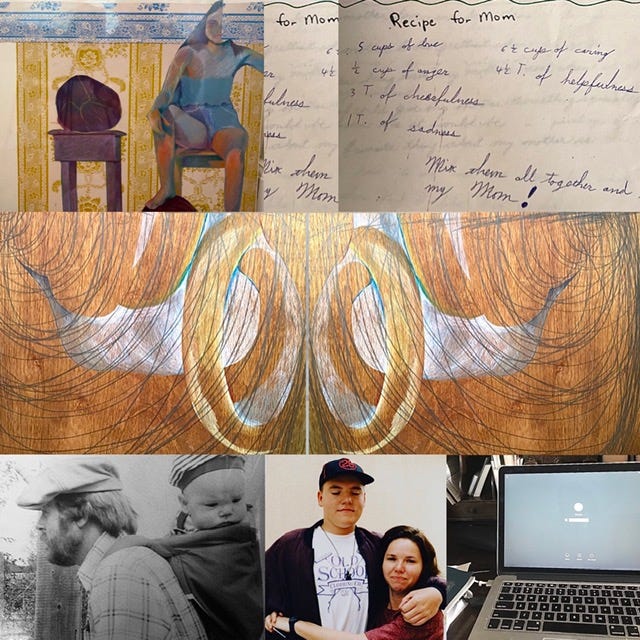
Of late the wind off the Pacific has been relentless and frigid. Walking of an evening it’s so cold. An old kind of cold. Slices right through a body. Set me thinking about loss and grief. The child I gave birth to and the children I didn’t. Forty-five years old and three months pregnant with a child I hoped would be a girl, a girl we would name Sally meaning princess and Greer the female version of Greg, my love. Sally Greer. Fresh faced and open to the world. Salty Sally squirming inside of me never made it into this realm. I still keep the positive for pregnancy stick in the top right-hand drawer of my dresser, wrapped in a piece of navy silk, hidden under the scarves and the gloves. A crone with her keepsakes still keeping possibility alive.
The veil between life and death as thin as a curtain it’s our senses which are thick. Clogged really. Like old pipes. I see my own life as a kind of kaleidoscope fractured and fragmented. A colorful whirligig of shifting pictures. Abstracted by time and emotion. What once was clear becomes lost to our vision just as another image begins to appear. Keep up I tell myself. You are no longer that girl practicing with her baton in the backyard. That dancing girl tap shoes clicking, or even that young woman afraid of her first husband. Basketball he called me. And sweet meat. You got a round head. Round, he’d say, like your breasts. Like a basketball. Since our trip to Oklahoma for Thanksgiving I’ve been thinking a lot about my first husband. Father of my only child.
That April day in 2021 when he died I felt a shift in my own body. Sat on the couch in the den alone pulling at the hair at the crown of my head. Plucking strands out of the damp ground of my scalp by the roots. One by one. He’d been a kind of king to me once. Broad chested. A high school quarter back. Bully in a sturdy pair of jeans. Walked with a cowboy’s gait. Talked in a southern mutter. Hard to hear. Harder to understand. Where’d you find this one his friends asked. A girl with dark hair And even darker eyes. He had a scar so deep it creased his right forearm on the diagonal. An old injury he said. Come from a summer job rough necking on an oil rig. Let me know he had balls. That I did not. Reminded me how weak and alone I was; how much I needed him. Backwoods body logic. The tradeoffs former foster girls often make. Someone’s giving you a home, a warm meal and a bed. Be thankful.
This is what girls do when they don’t have anyone.
The boy child I made with him was surly and stout. Like his father. I did not take the child with me when I left his father. Ran down the front steps of the shotgun house we shared my clothes in a trash bag my son in his bed.
Ironic burden of history and of my own stubborn heart pushing me forward.
When my first husband died I had not been in touch with him or my son for many years. I discovered my ex had died because I followed my son on Instagram. He’d posted about a memorial service for his father to be held at the private high school where his father had taught for many years. He would be buried in the small-town Oklahoma graveyard where his parents were buried. I immediately sent my son an Instagram message. Expressing condolences for his loss. Letting him know I was here for him. There for him. Anywhere for him. As I had done for many years I sent a message through a digital bottle. Here’s my address, my phone number. I love you. I am here for you. Always.
My son was forty-five years old when his father died. He and I hadn’t seen one another for twenty-eight years.
I’d left the marriage. But I did not leave my son. I always came back when my son needed me. I came back when his father’s kidneys failed. And our son was wild with anger. Why didn’t anybody tell me he was sick? he screamed. I let him scream. And rant in the front seat of his dads rusty pick up. I listened to him wail. But I didn’t tell him what I knew about his father. I’d made a promise to myself to never ever diss his dad. I didn’t justify or explain myself away either. I swallowed all the conflict down into my own bottomless belly of regret. The years of trying. Taking the blame. Erasing myself until all I could do was run.
Women who leave know how to take the rage aimed at them but not meant for them.
Seldom meant for them.
Taboo to the myth of motherhood is the mother who leaves. I didn’t leave. I moved to another state to get an advanced degree so that I could make more money to contribute to my child’s life. Women who leave despite gains in gender equity are often considered deeply flawed. People like Yoko Ono. Doris Lessing. Louise Nevelson. Artists. Writers. Workers of all kinds. Women who leave to make their work. To study. Women who leave in order to fulfill their own destinies do not deserve to lose their children.
There’s an Australian film I love wherein the protagonist played by Judy Davis is a rock’n’roll singer who gets stranded in a small town after losing her job in a band. She winds up in a trailer park only to encounter, by accident, the teenage daughter she deserted. From the first viewing I was transfixed by her character. Her curiosity and detachment. Her seemingly cold-blooded acceptance of the decision she’d made so long ago. The facts of my estrangement from my child were different.
I did not desert my child.
When I divorced his father the last thing I wanted was for my son to lose contact with his father. A boy needs a father is what I told myself. So, I suggested joint custody. It was 1981 in Oklahoma. The judge said this won’t work. You’ll be back in court. I trusted my then husband to file the papers. Agreed on the days he wanted with our child and took the time I was given. I was making it up as I went along. Twenty-nine years old when we divorced. Eleven years transitioned out of foster care. Still estranged from my family of origin. Our son six years old. Watching me draw and paint. Coming to work with me at the Oklahoma City Zoo.
Shopping with me. Cooking with me.
I finished my undergraduate degree when he was eight years old. When he was nine I applied to graduate schools. When my son was ten I moved to Los Angeles to go to graduate school. The two of us flew for visits back and forth from the edge of the country to the center, back and forth for years.
Until that last visit.
At first I was shocked by the blow up between us. The cruelty of his father’s words coming out of my teenage son’s mouth. You’re fucked up. Your parents fucked you up.
I was driving. He was in the passenger seat. Screaming. Telling me he would leave and never come back. I would never see him again. So like me his threats. So like me at his age. Knocked me back. Threw me into a PTSD trance. So frozen I didn’t try to make him stay. I sat on the couch in the apartment I shared with friends zoned out. I suffered with trauma I’d kept secret even from myself. Completely isolated from those who could remind me because they had suffered too: my siblings and cousins. I needed the support one generally received from family. I needed therapy. A trusted friend. A respected authority figure. I lived in terror that Mama would find me and kill me. I kept my phone number unlisted. Contact with family members limited. No one came looking for me. No one tracked me down. I was the outsider the one who got away. Not belonging became a central piece of my identity. One of my roommates took my son to the airport.
I didn’t think our estrangement would last as long as it has. Long enough for me to age from forty-two to seventy-two. For him to become a man in middle age.
When his father died, I was left out of his obituary, an obituary written by the child who came out of my body. Written as if he’d never known me. As if his father had never met me or wooed me. Married and betrayed me. The obituary named the deceased man’s only child as someone who he raised as a single parent. The image published with the obituary was a black and white photo of the deceased with our son when he was an inquisitive toddler riding on his father’s back in a backpack. I took that photo. That photo of a supposedly single father was taken by the child’s mother.
A woman erased from their lives. A primal betrayal.
Men who believe they own us often steal our children from us.
April of 2022 I sent an email to my son’s stepmother, a woman who had been married to my ex-husband for nine years before divorcing him herself. I told her that my current husband and I were coming to Oklahoma to visit an old friend. That I was worried about my son. Wanted to know how he was doing after his father’s death. I’ve never stopped reminding him that he has a mother who loves him and wants the best for him. Now that his father is gone I’m concerned more than ever about his wellbeing. Would you be willing to meet me for coffee or talk by phone to give me a better idea of what is going on with my son? I would greatly appreciate it.
My son’s stepmother emailed me back. She wrote that she had no information for me. But. I was resourceful woman so she was sure I could find him myself. She added that when she knew him he (my son) had never expressed any desire to be reunited with me.
Life and time, she wrote, does mend many broken things.
If I were you, an editor I once worked with volunteered, I would camp out on his doorstep until he listened to me, paid attention to me.
That kind of confidence doesn’t live in me. I never assume I have the right to force myself on anyone not even my own child. I am unwilling to stalk anyone especially him. I am unwilling to show up at his workplace unannounced. Unwilling to be like my own mother.
I simply added this new erasure to all the others.
The consequences of which I have yet to fully articulate even to myself.
I try to tell myself that what matters most is how I view my own decisions — not how someone else judges the decisions I’ve made. Often as a preemptive defense I judge myself before others can. I judge myself harshly. Call myself a loser, a quitter, not good enough. Self-deprecation almost a theme of my life. Everything I write about converges around loss and abandonment, sadness and estrangement. Such a loser I say to myself, ironically.
My life is crazy.
Never thinking that one day that judgement would boomerang right back into my face.
This Thanksgiving we drove to Oklahoma City to spend the holiday with my oldest friend there. She was newly widowed, in need of company. Three long days of driving. San Diego to Flagstaff. Flagstaff to Tucumcari. Tucumcari to OKC. A route I knew well from a childhood on the road. A tiring drive which we were happy to make. To be with my friend our friend now. To share the Thanksgiving meal with her friends. A few days before that shared meal my friend let me know what one of her friends had shared with her about me. My friend had invited her friend to come for Thanksgiving dinner, so she needed to let me know about the conversation she’d had with this friend, a woman I had never met.
My friend drank her tea, and I drank my coffee as she told me what her friend had said to her on the phone when she found out I was visiting.
“She said she’d heard you were crazy and a bad mother.”
“Who did she hear that from exactly?” My ears ringing. My heart beating too fast.
“She’s friends with your ex’s wife.”
As my friend spoke I struggled to parse out what she was saying. Two women who I had never met, one who used to be married to my first husband, the other a friend of one of my oldest friends in Oklahoma, these two women who had never met me had talked about me. Gossiped about me. Judged me. I sat there listening. All at once able to connect the dots. Through decades. All those years believing I deserved my son’s rejection, my son’s anger at me sliced right open. My leaving for school weaponized. Kept in my place by their adherence to convention. Ashamed and insecure. And afraid. You’ve been afraid your whole life my son once told me in a late-night phone call. You are so afraid he said, and it’s made you very easy to manipulate. Easy to manipulate and porous with grief, ambushed by such complicated grief. People who I don’t even know undermining me like some bad soap opera plot: loved ones kept apart by scheming deception and also the target’s self-doubt. Who did I think I was? Before foster care, since aging out, in childhood, then adulthood, even now as a crone, every time I’d tried to excel to put myself out there I had asked myself that old self-limiting question.
Who do you think you are?
I didn’t know anymore. Because I didn’t have the right words yet.
What is the word for when you are hit with transfiguring psychic pain? When you recognize how much of your pain has been purposely inflicted? When you realize how over time you’d internalized other people’s poor treatment of you. I’d gaslighted myself for them, for others, told myself I was blowing things out of proportion, or worse, that I had done something to deserve being cut out of my son’s life. I wasn’t crazy. I was angry. For years I was mad with anger and bewilderment and shame which made me weak and unable to fight. Too weak to demand my rights as a parent. I was one of those women rewarded for her silence called crazy when she spoke up. Told she was untrained and in need of more schooling before she could tell her story. Dye your hair. Lose weight. Consider a face lift. Make your too sad story more entertaining. Funny. Tell it slant. Be ironic. Take another workshop and then another. And another. Until before long you are tamping down the anger and bewilderment word by word sentence by sentence censoring yourself as you draw, paint, think, write, live.
Flattened into an acceptable mold. More conventional. Controllable.
Further from the truth.
Better yet. Keep it to yourself.
New Year’s Day I put the black-eyed peas on the stove to soak and got out my vegetarian recipe for Hoppin’ John. Although it’s believed to bring luck and peace in the coming year to anyone who eats it, Hoppin’ John’s history is anything but peaceful. I cooked all morning chopping and slicing, ruminating on all I could not change. Some problems are solvable, the more you think them through the more the various possible and eminently practical solutions converge into a kind of reliable recipe. What’s the best two wheeled conveyance? It might look and work a lot like a bicycle. Other dilemmas slip and slide away from easy solution. The more we ponder the most important problems of life the more the seemingly possible solutions diverge: world peace, human connection, devastating illness, poverty, how best to safeguard our fragile planet, our communities, our loved ones, and ourselves.
After a bowl of Hoppin’ John I sat down to write this essay.
I began the way I’ve always begun. By typing a permutation of my son’s given name and date of birth into the login bar on my computer screen. Some form of his name has been my password for every computer I have owned since 1993.
For thirty-two years now, every time I sit down to write I’ve typed his name in.
Like a prayer.
Don’t Make Me Stop This Car! has been live a year and a half. It’s time to turn on payments. Which will remain voluntary. I will not paywall this writing. I’m grateful for every reader. Every comment. Every restack. I jumped off my family tree. There was no other way. The tree was falling. There’s still so much I want to share about the process of aging out, of childhood trauma, foster care, and life afterwards. Look for an option to contribute to my efforts in the coming month.
Just when I think you've written THE best, you go over the top again. I can see you and hear you speaking every word here. Prayers up for you and Eli and Sally.
Gorgeous and fierce truth telling. Thank you.