
Common Cent$
Come from aging out of foster care

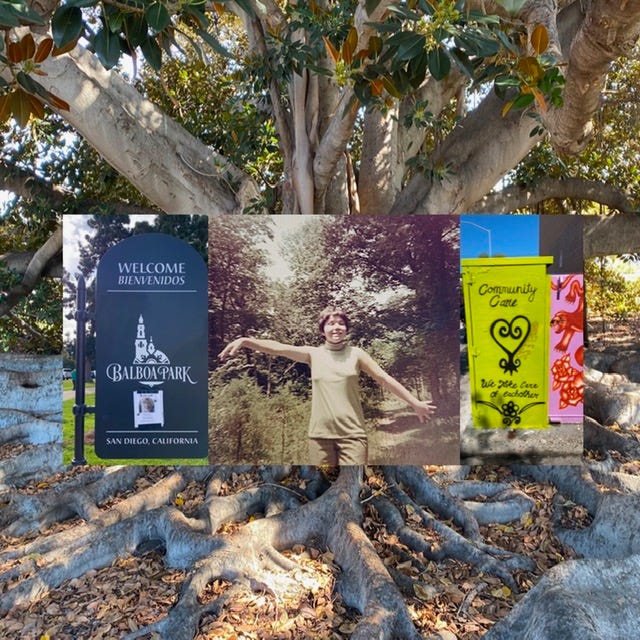
Last month I posted a photograph via Substack notes which has accumulated more looks, likes and comments in the past few tumultuous weeks than any image/text combo I have ever shared on social media. A photo of a Ficus tree growing in Balboa Park, alongside a simple description: This tree is one hundred and fifteen years old. I stand beneath its branches in awe. I love walking in Balboa Park. After the last five life altering years, too much time spent indoors, watching screens, learning vicariously, I enjoy being more in the real world. A flesh and blood body moving through the green, the sky a comfort, a see-through lid of possibility.
Balboa Park is a 1,200-acre historic urban cultural park in San Diego, California. Placed in reserve in 1835, the park's site is one of the oldest in the United States dedicated to public recreational use. San Diego county, the southernmost county in California, a county which borders Mexico, is where my husband and I recently relocated after living in Los Angeles for half of my life and all of his. San Diego is where I lived off and on when I was a young child.
A city built around a public park.
The man I believed to be my daddy took us to Balboa Park often. Also, to the Zoo, where pink flamingos greeted us. He took us to the beach where I left footprints in the sand. He took us to the ocean, and he took us to see snow in the mountains. He took us to Disney Land where we spun around in a giant teacup and laughed at scary mechanical characters. We were able to laugh with him because we thought we were safe. I thought we were safe until. Until it all fell apart. Until a knife fight in the night all through our house across my twin bed and out the front door. Until Mama screamed “Get up and pack!”
And we were off.
Blood on the floor as we scurried out the door. Just kids. Not fully understanding what was happening. Where we were going.
Hard to know how to strategize when the bottom falls out. I was a small child along for the ride. Without a voice. And alone with Mama. On the run with Mama. That first trip there were three of us kids. I was the oldest, eight years old, almost nine. My first sister was six. My first brother was three. In the next year my twin sisters would be born. Then another sister and another brother. All of us along for the ride. With no choice. Making the best of it. I read and dreamed and looked out the car window trying to imagine what other people’s lives were like. I took care of my younger siblings. I read when I could get hold of a book. From the school library. Or the public library.
I attended public schools.
I swam in public swimming pools.
I played in public parks.
Public and available to all for free.
Schools, and libraries and public parks saved me when I was a kid, with so little of my own, shared public places gave me a way to move in the world, to test my powers, to learn and grow.
Are you paying attention to what is happening to communal space?
The least we can do is to recognize what is happening. Rich men in charge. Morbidly rich men. Politicians right and left agreeing to keep poor children poor. Agreeing to put us all in more danger. This isn’t new. It’s happened before generation after generation. But it’s our new. It’s our now. And we must face it. I get it. It’s scary. It took a long time for me to become bodily aware of what had happened to me. To all of us. How dependent and poor we were as children. It has taken decades for me to fully understand and recognize how poverty affected me.
Affected all of us.
All of us kids in the car. With our weak bones, our leaky hearts, our beaten down hopes. Our longing to breathe deep and free out in the open.
Public space. Common ground.
I gravitated towards the common areas, the communal spaces, the public places open to everyone. Places not privately owned. Like, the seventeen schools I attended as my troubled mother traveled back and forth across the Southwest U.S.; school was my through line, my solace, and my support. School provided a sense of community. Attending public schools gave me a look into other ideas about how families lived. I sat next to children who were not like me. We became friends. Together we learned how to live alongside one another, play together, fight fair. School was my father and my mother; the place I heard someone say, "well done”. School was the place where I excelled, despite not having all the stuff I needed to excel.
School was where I got a free lunch when I was hungry.
Children raised in poverty are more likely to experience food insecurity, homelessness, and other hardships. They are also more likely to have lower educational attainment and lower lifetime earnings.
A poor child knows she is poor. She feels the lack in her body.
Money for food, shelter, healthcare, clothing, books, toys, recreation, privacy and time. Time to learn. To imagine who they are and what they want to be. Without access to resources generational poverty persists and continues long past childhood, pulling children down into the quicksand of generational poverty. During the pandemic, spending on children surged in the form of tax breaks, and subsidies for health care, food and education. But that didn’t last. According to US Census Bureau data, over 9 million kids in the United States still live below the federal poverty line. Without access to basic necessities. Poor and feeling as if it is their own fault they are poor, when it is not their doing.
It was not our fault that my siblings and I grew up poor and vagrant.
The first few weeks in foster care, after I ran away from my abusive home, after I used my voice to ask the state of Missouri to put me under their care so I could get back into school, have a place to live, after that first rush of freedom, I was reminded of exactly what I was worth. It happened on a shopping trip with my foster mother. I needed clothes to wear to school. Our outing was a delight, something I had never done with a mother figure before. So much fun. Carefree until we reached the cash register, and my new foster mother asked the clerk for a receipt in triplicate so that she and her husband could be reimbursed for the money spent. They were a young couple just starting out. Opening their stable home to a young girl without one. I understand now the necessity of their being reimbursed. Now I am more than grateful. But at the time I wasn’t grateful.
I was hurt and angry.
That night I sat in their bathtub for a long time. Skin puckering. Mind shivering in recognition. Wondering if I was worth the cost it took to keep me. I sat in lukewarm water calculating how much it cost for me to take that bath. I itemized everything. The water. The soap. The washcloth. The heat keeping the room warm. The towel I would use to dry myself off. The pajamas I would slip on my body. The bed I would sleep in alone. At last. The clean sheets. Breakfast the next morning. How much did it cost to keep me alive.
I aged out of foster care in 1970. Fifty-five years ago.
According to the Annie E. Casey Foundation “When kids “age out” of foster care — which is the fate of about 20,000 young people annually, though this is declining — they often lack the support and connections needed to thrive in adulthood. Emancipated youth are more likely to report being homeless and jobless when compared to peers who have achieved permanence. They are also more likely to experience incarceration and early parenthood.”
Connections to family help us to flourish. To grow deep roots. To reach for the sky.
Permanence. Planted. In place. Always there. There to come back to.
When I read that word I shivered. I have never had a family who could or would or were able to always be there for me. Permanently.
Since aging out at eighteen I have managed to achieve a fragmented family permanence. Friends have become like family. My former foster mother has become a family friend who I love and cherish. My husband is my best friend. Together we have made a family. I am close to some blood kin: one particular cousin on my mother’s side, my first brother’s children, a niece and a nephew who I met later in life, a few of my maternal siblings: a long-lost brother, found and then lost again, a surviving twin who I haven’t hugged in years and long to, a sister who used to call me mommy who texts with me often. My two paternal siblings keep their distance. Unable to integrate the reality of me into their family system. To them I am the girl come from that other woman. The sister kicked out. Her ties to parents, siblings and extended family weakened by poverty, vagrancy, abuse, neglect, and an age-old mistrust of authority.
I still struggle to make sense of the family I was born into, the world we were given. Still, we are family. Over time I have created a community. At times fragile. Always valuable, and hopefully permanent.
Permanent. The word haunts me.
I am only now in the writing and research for this post realizing I did not have a lifelong parent. I had family impermanence and struggled to provide a sense of permanence for myself and my only biological child. I’d thought when I left my abusive mother I’d be able at last to make my own way. On my own.
Make your way, make your own way, out the door and out of the house, down the street and out of town, across one world and into another, out of the past and into the present, remake and re-beautify, again and again, the path from loneliness, retrod and retold.
I made my own way, but I did not make the journey on my own. Every important accomplishment in my life I have achieved with the help of community.
Now. Here I am again. In old age. Once again dependent on social services. On money paid into Social Security, on money taken out of every check I’ve ever earned.
I began paying into Social Security at the age of fifteen. I’ve contributed to those funds for a very long time. From before foster care, while in foster care, and then while transitioning out of foster care, without parents, without a permanent family. According to my Social Security statement, from the age of fifteen through the age of twenty-eight, I earned $8,692 dollars. Hoeing peonies, sickling corn, serving food in the Oklahoma Christian College cafeteria, shelving books in their library, checking on the elderly in a nursing home down the street from the house I shared with my roommate Linda. Next I got a job in a preschool. After that I worked in a library again and would work in libraries off and on during my first marriage and afterwards when I was divorced with a child. My pay increased once my child turned four, began attending preschool, and I was able to get a full-time job at the Main branch of the Oklahoma City library. First I worked as an assistant to the reference librarians. Then as a circulation clerk in a branch library. While working I took classes so I could finish my undergraduate degree. I wanted to go to graduate school. Not only to make more money. I wanted to keep learning. To learn more. Always. I thought if I knew enough, if I knew more, if I understood more, maybe I’d be able to live my life differently from my mother’s. Make my son’s life different from mine.
I didn’t think I was good enough. I needed to improve. Be better.
To save for graduate school, I got a second job at a boutique hotel working the evening shift registering guests. During the day I was the librarian at the Oklahoma City Zoo. I was always working. Working made me feel I was worth something. In grad school I worked in the library assisting the film librarian.
I was only able to attend college and graduate school because I had student loans, Pell Grants, and work study jobs.
All the jobs. The jobs were endless.
My first job was fieldwork, roguing seed corn for a state-run agriculture business. Fast moving me marching down corn rows with a sickle. In my last job, I was a part time reference librarian for the Santa Monica public library system. Helping the unhoused find local services and checking out meeting rooms to study groups and frugal entrepreneurs.
Like most kids who grew up poor I have never not had a job. I worked hard but I wasn’t strategic about working. At the Los Angeles Times where I worked for seven years in the 90’s I didn’t know to buy into the pension plan immediately. I didn’t stay anywhere long enough to accrue a good pension. I hopped from place to place always curious and not thinking about the future.
Every day I worked I paid into my Social Security account.
In 1935 when then President Franklin D. Roosevelt signed the Social Security Act it was meant to be a federal safety net for elderly, unemployed and disadvantaged Americans. It was and still is funded by workers paying an extra tax on their payroll and wages.
I grew up on financial assistance provided to families deprived of a father’s support. Mama called it her ADC money. Still. Aid to Dependent Children wasn’t enough to fill the emptiness of being alone with her and fatherless.
Unsupported.
My mother died in her car. My first brother lives between the streets and jail. My first sister died of an overdose in her mid-forties.
Hard to put down roots when you are vagrant.
Hard to rely on family when you do not have a permanent family.
Hard to build community if we aren’t supporting equity. Equity in the true sense of the word. Not the value of property. The value of people. All people. Fairness and justice in the way people are treated. In the real world.
Over a thousand people on Substack have hit “like” for that photo of the old Ficus tree I posted last month. But those “likes” aren’t as real to me as the real tree in front of me or the people I was with when I took the photo.
I discovered that old tree while on a walk about in Balboa Park last month with my husband and his daughter, my remarkable stepdaughter. Like me that old tree in Balboa Park is a transplant. Ficus macrophylla is a native of east Australia. It was planted as a small tree in a garden for the 1915 Panama-California Exposition. After decades of too much foot traffic across its gigantic roots in 1989 the tree was trimmed and fenced off. Protected and mulched the tree has recovered and once again shows thick, glossy foliage. I stand in awe of that one hundred-and fifteen-year-old Ficus tree still growing in Balboa Park the city’s 1200-acre backyard. I am as much in awe of that old tree’s resilience and longevity as I am of the fact that I am still alive to collect the Social Security I earned.
The safety net I have paid into for most of my life.
Notes
https://unitedwaynca.org/blog/child-poverty-in-america/
https://www.aecf.org/blog/what-is-foster-care
Thank you for this. We have lost sight of the common good. We ALL need those public spaces. An isolated person becomes soul-sick, no matter how wealthy.
Love the connections you make with your story and the stories of public life and poverty. Really well written, Chris.