
Big Sister
Last of the First Three Come Full Circle

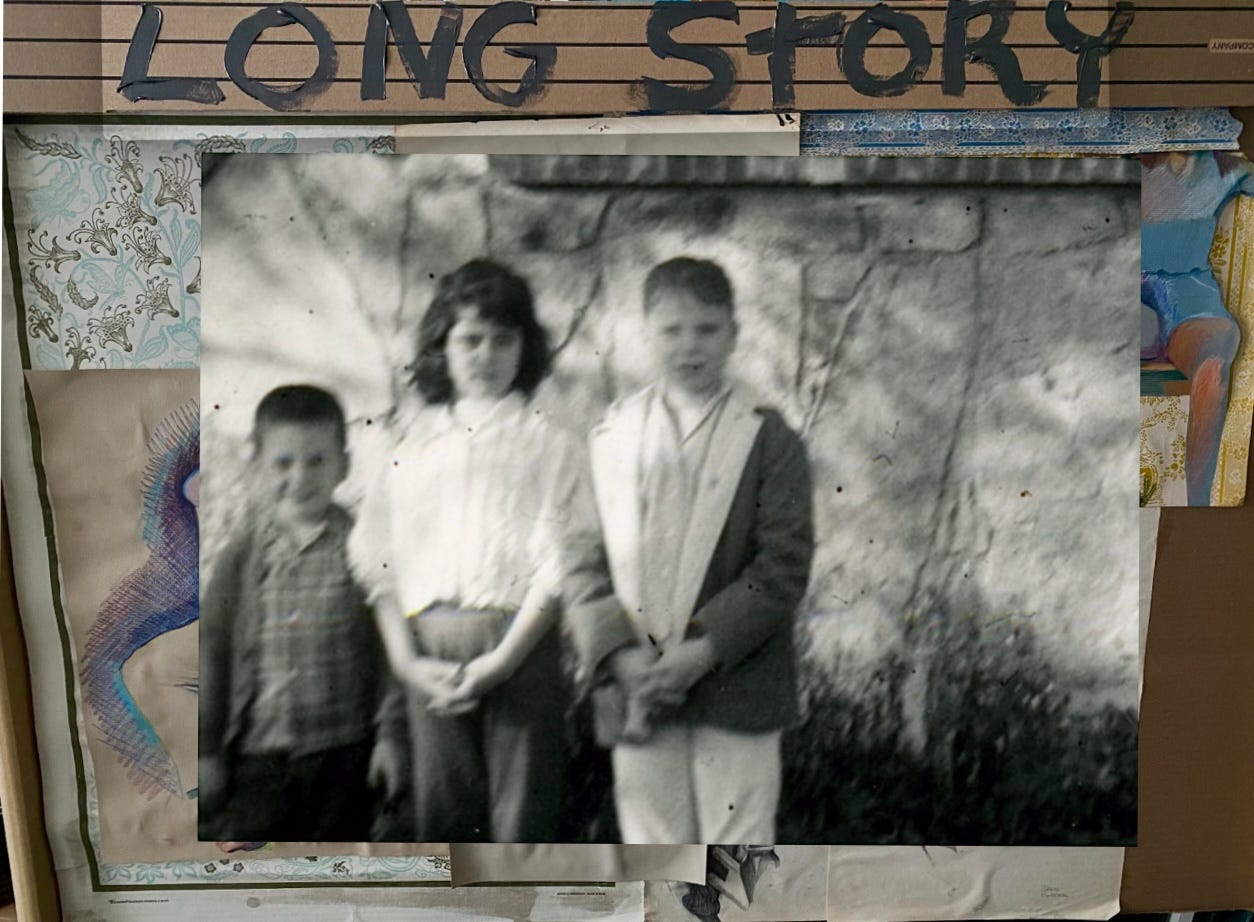
For a long time, there were only three of us kids living in a house with one Daddy on Lake Atlin Avenue, in La Mesa, California. The house smelled of new grass and hummingbird treats. In the summer of 1959 when we moved in, I was six, my sister Susie four, my brother Stevie a baby. At night I hid behind the bathroom door listening as our parents screamed. Mama changed the furniture too much. Daddy didn’t wear the right clothes. “You don’t deserve those kids. You’re a terrible mother,” he’d say. Crashing and breaking, screaming and crying moved from the living room down the hall, into my sleep. Then Daddy moved out and gave Mama the house across the street from Grover Cleveland Elementary School. He also left her the family car, a 1962 Rambler American sedan.
As soon as he was gone Mama moved her new man in. She said she was renting him a room. But he already had a house and a wife and children nearby. One day his wife called our house asking for him. “You mean, Uncle John,” I said. “Mama told us to call him Uncle John.” Mama grabbed the receiver from me and told Uncle John’s wife to bug off, that he was in love with her, and they were going to have a baby.
Uncle John had been living with us for a few months when one night Daddy broke into the house. He cut Uncle John up with a bottle opener. “Call the police,” Uncle John screamed. “He’s cutting me to ribbons.”
I still dream of men fighting through the house with knives. Boogey men. Unreliable men. Damaged dads who fought over Mama and lost, then abandoned us and left us with her.
“Get up and pack,” Mama told us the next morning. Loaded up the Rambler, and off we went. Away from the only home I’d ever known.
Nothing was mine ever again. Not my toys, not my room, not my school, not my friends, not my lessons, not my Daddy. Not my body. She could take it all away from me and she told me so every day.
“You are mine,” she’d tell me. “But I don’t want you. No one wants you.”
For the next eight years she dragged us from place to place, taking us out of school anytime she wanted to leave town. Caused us all kinds of trouble. As she drove I listened to her talk, fearful of what might happen next, to me, to her, to my younger siblings.
The twins were born on September 27th, 1962, in Joplin, Missouri on a blustery fall day, winter in the air, the stinky leaves on the Pawpaw tree in the front yard of our rental on 10th Street changing color and falling onto the sodden ground. Mama put Daddy Ralph’s surname on their birth certificates, then wrote to Uncle John, their actual father, to inform him he had two daughters.
John wrote back and I read his letter.
He wanted to straighten out his life and that’s what he intended to do. He did not want to have a common law relationship with her. That was not his plan. He loved Mama and wanted to give his name to the twins. As far as his wife was concerned, well that was over.
Mama immediately loaded all five of us in the Rambler and drove back to San Diego.
On the way I took care of the new babies in the backseat of the car. In San Diego we lived with Uncle John in a house in El Cajon for a few weeks and then Mama got upset about something that didn’t go her way, and we packed up the car again and drove back to Joplin, Missouri.
In Joplin we lived in a rent house on Wisconsin Avenue. School began and she started seeing another man, a stranger in the night. None of us kids ever met him in the daylight. I only caught glimpses as he left every morning. “You sound like a newscaster,” he said one night, in the middle of who knows what and for reasons I did not fully comprehend at the age of twelve. I was up spying on her as usual. Listening through the door. Worried about Mama. Worried about everything. The only way I knew to discover what she might be thinking of doing next, was to keep my eyes and ears on her day and night. Ever vigilant.
“Keep them quiet,” she’d tell me, let me know the safety of her babies was my responsibility.
I tried my best to protect them. If her green eyes flashed red and simmered into a glow I knew she was ready to attack. If she went mute I knew we’d be on our own for days, scrounging for food.
It seemed as if we were always hungry.
Money came once a month from Daddy Ralph back in California in the form of child support checks. She cashed his checks at the IGA Thriftway South and bought beans and ground beef, bourbon, and hand soap. While she was there she stole what she could. Stealing never bothered Mama. She thought it was funny how easy she got away with taking what she wanted.
When the twins were born they were premature and very tiny; Marcy Lee, the newest baby from the stranger in the night was beautiful but scrawny. Daddy Ralph’s child support check wasn’t enough to feed the six of us. So, Mama applied for Aid to Families with Dependent Children (AFDC), a federal assistance program in effect from 1935 to 1996 created by the Social Security Act (SSA) that provided financial assistance to children whose families had low or no income. While she waited for approval Mama bartered. And. Raged. Raged until she fell on the couch face down in a heap of desperation. Most nights we stayed outside as much as we could, chasing fireflies and playing with the neighbor kids.
One day while I was at school, Stevie burnt the overgrown field behind our rental down and Mama kicked him out of the house. Made him live outside in the bushes and under the porch. He was seven years old. Mama’s sister Jo called Daddy Ralph and told him he better come get his kid. Mama could not stand him any longer. He was too much of a problem: he cried all the time, ran away from school, and caused trouble with the neighbors by stealing things, destroying things and setting fires.
He needed Daddy Ralph. I needed him too.
After the twins were born, I’d met Gene Smith, my biological father, for what seemed like the first time in my life, having forgotten him just like he had forgotten me in the intervening years. Real Dad brought me gifts: a set of classic books, which Mama hocked for cash, and a chunky gold ring, which I lost in the tall grass growing around the water faucet outside. He was my father, but I couldn’t look him in the eye or stand it when he brushed my hair off my face.
He was my father by blood, sure. But I didn’t feel like he was a Real Dad.
Daddy Ralph was the one who’d taught me addition and long division, to never cry wolf and to come home when he whistled. Daddy Ralph was the kind of daddy who never went away and when he did I knew somehow he would always find a way to come back. He wasn’t my daddy, or Susie’s daddy or the twins’ daddy. He was only Stevie’s daddy, but at least he knew how to be a daddy. And I loved him for that.
“You didn’t really think he was your father did you?” Mama asked me as I cried,
devastated to learn Daddy Ralph was not my Real Dad, that Mama had lied to me in a really big way, that all of my siblings were half siblings, that the man who’d helped to make me had given me up time and time again.
I never called any man Daddy ever again.
When he learned his son was living in the field out back Ralph came and took his only biological child away from Mama. Scraped the money together to make the long drive east from San Diego to Joplin, Missouri to rescue my baby brother. Loaded what little Stevie owned into his red El Camino and sped away, leaving my sister Susie and I behind.
“When she left your father she wanted to keep you girls,” Ralph told me years later. “So, I adopted you both. It cost money and everything. But I did it. It was the right thing to do. What a dummy. After that, things started going downhill. Then, after the divorce my attorney said I didn’t stand a chance in hell of getting both you, and your brother,” he explained. “Told me unless the mother was the absolute worst, there was no hope. I told him, you don’t understand, she is the worst, but I admit I didn’t know how bad it truly was. Not really. I thought if I got him away from her, he’d be fine.”
None of us were fine. Especially the first three.
Me, brooding in the backseat; a girl driven to understand what had happened to her family.
Susie, side saddle to Mama; year after year turning ever more inward, a girl who would die alone in a motel room.
Stevie, huddled on the floorboards; longing to soar over the earth like an eagle, a boy who would die in a bush by the San Diego River.
Did any of us matter to Mama?
The question I could never afford to ask myself when I was a child is the question I ask myself now. Now. After the death of my baby brother last fall, the third sibling to die too soon and horribly alone. Now I am old and closer to who I was before all the traumas. Old and still burdened all these years later, by the damage done. Her sadness settled into our brains where it formed tight knots of guilt and shame. I know because I am the one she relied upon, the big sister, the eldest of her nine children. Weighed down by a story I still struggle to tell in a world grown more callous and indifferent by the day.
Living in San Diego again, amidst the cozy chaos of memory.
A big sister come full circle.
In 1962 Ralph Edwards sued Doris June Edwards for divorce, and I read the legal papers she cast aside with a snicker on the kitchen counter of our current rental. I was ten years old.
Since the marriage of the parties defendant had treated plaintiff with extreme cruelty and has wrongfully inflicted upon him grievous mental harm.
I’d overheard Mama accuse him of everything from infidelity to murder. She continually degraded him to us and fought every effort he made to be a good father and husband.
The divorce decree stipulated that: the care, custody and control of the minor children, Christy Jo, born September 2nd, 1952, Susan Marie, born August 5th, 1955, and Ralph Steven, born May 6th, 1959, be awarded to Doris June Edwards, their mother, subject to reasonable rights of visitation by their father, Ralph H. Edwards. Daddy Ralph was also ordered to pay Mama the sum of $35.00 a month for each of the three children he claimed as father. Until each child married, became self-supporting or until further order of the court.
The divorce complaint was issued and served to Mama while we were living in Texas. I hated Texas. Texas was a bleak and ugly place. The kids at school were strangers. Mama was sick and mopey and bored. She called up Daddy Ralph in San Diego all the time saying this or that was wrong, or she wanted this or that. After a few weeks she decided she couldn’t get along with her folks, and we moved to Joplin where her sister Jo lived.
Not long after Ralph rescued my brother and took him back to live in San Diego he sued Mama for custody of his son. Legally declared it quite obvious that Mama had no moral standards and little concern for the wellbeing of her children. After Ralph died the custody suit papers were found by my niece in a metal box on the top shelf of her grandfather’s bedroom closet. Faded Filofaxes I read sitting on the floor of his home office knowing every accusation to be true.
She was brutal to her children, especially her sons. She never took care of any of us. We were allowed to eat food off the floor, went unwashed for days. The babies went around with dripping wet diapers, bottles in their mouths all the time. Raw and sore from going around in dirty diapers. She kept us in the best and latest fashion, gave us clothes and elaborate toys, plenty of candy, cake and ice cream, but hardly ever cooked or cleaned our clothing. She just bought new. We didn’t have money, but what we did have was spent immediately.
“Money is for spending,” she would say. “The future will take care of itself.”
She laughed and giggled when her unattended children did dangerous things and got hurt: Susie swallowed a bottle of aspirin and had to have her stomach pumped, Stevie fell on a toy flute and seriously injured, had to have the roof of his mouth reconstructed. Every time she approached me I held my hands over my head for protection. She told people I was emotionally sick, that I acted strange, but she never talked to me, held me, or got me help of any kind.
“I don’t care,” Mama would say if anyone questioned her parenting. “I can’t worry with them.” Then, she would go to bed for days.
Once in a while she would be very nice, then for no reason become a demon to everyone. She spent most of her time on the phone going through buy, sell and swap want ads. Drove around town endlessly, looking to buy furniture, clothing, anything. She was a careless driver, slamming the brakes on, throwing her children to the floor of the car. She laughed at this and talked about all the times she and her sister, our Aunt Jo, had run red lights, and when caught, had talked the officer out of a ticket. She was not interested in home, children, settling down.
“I can do that when I get old,” she would say. “Now, I want to go places and do things.”
Mama lost the custody suit. My brother Stevie would live full time with his father Ralph. Susie and I stayed with Mama. Our adopted father was ordered by the court to pay child support, in exchange for legally surrendering all claims to us.
Mama married her attorney Mr. Brown, and he became husband number six.
Mr. Brown bought us a big house in El Cajon and furnished it with antiques. We had nice bedrooms and lots of food in the refrigerator. When we were almost comfortable she grew restless again, locked Mr. Brown out of the house he’d bought, loaded up her Rambler American and took off for Missouri.
Left him behind like all the others.
She gave birth to his child, our brother Tommy, a few months later.
Tommy was Mama’s 7th child and Mr. Brown’s only biological child. But Mr. Brown never sued Mama for custody of his son, Tommy, no matter how badly Tommy was treated or what stories filtered back to his law offices.
I was fourteen years old when Tommy was born, a freshman in High School, when I could make it to school. Mainly I was kept home to help with the new baby. He was the most beautiful baby. When I looked at him, heard him cry, I died inside. I could not take care of another baby in the backseat; nurture another fragile life when my own was so broken. Somehow I convinced Mama to let me live with Real Dad, his new wife and their two toddler daughters. Mama said yes, because she had a new man and wanted me out of the picture.
In 1969 she married her seventh husband and gave birth to her last daughter, Laurie. The marriage didn’t last, of course, and within a year she wanted me back. By then Real Dad’s wife, my stepmom, had kicked me out of their house. I didn’t know what I was going to do but I knew I would not go back to Mama. When she came looking for me, I ran away from her and asked the state of Missouri to put me into foster care.
A few years later Mama married again. Her eighth husband was a cowboy who worked at a dude ranch outside of Wickenburg, Arizona. That’s where she gave birth to her last child, a brother I have never met. I’ve heard his father wasn’t Mama’s husband. I’ve heard his father was another man, a wilder, crazier man, a dangerous man capable of much bodily harm.
Once I tried to track down every time she’d said, ‘I do’, but lost count after number eight. I finally stopped looking, dizzy from all the permutations of her given name she’d used over the years. Married or not, she gave birth to nine children by eight different men. Children abandoned by their fathers and neglected by their only mother; children who were maltreated and alone, without protection. Few of their fathers were brave enough to rescue them from her merciless disregard.
Only Daddy Ralph, my brother’s bio dad, came to his child’s rescue.
Without his influence I don’t know where I would be.
“I’m a kitten,” she’d say, giggling. “A restless kitten.”
We lived on the run. Never in any one place for more than a year or so before she packed us up and took off across country. I was eight years old on the first trip and fourteen years old on the last. In those seven years we crossed the Southwestern U.S. five times. Year after year we traveled back and forth between two pinpoints on the map of Mama: San Diego, California in the West and Joplin, Missouri in the Midwest. In San Diego she’d try to get money from one of her children’s fathers. In Missouri she would nestle into the tangled knot of her own primal anguish: her parent’s modest house on Texas Circle. The only place she knew we would be greeted with food and lodging: a bowl of beans and a bed in the spare room at the end of a dark hallway.
Year after year, small bodies stared out a car window, helpless, listening to the drone of a voice, pitiless, and naïve, a horrible combination. Houses never furnished. Refrigerators full of liquor and doggie bags, a toddler hidden behind beige drapes peeing on the carpet. Babies crying. Poodle yelps. Flash of ocean daylight. And remorse.
She loved the southern route, following Interstate 40, a highway hugging what was left of Route 66, the Mother Road. I would come to know that route by heart. Could anticipate approaching towns: Oklahoma City, Amarillo, and Albuquerque. While Susie sat up front holding her poodle Pierre, I sat behind the driver on the sticky Naugahyde backseat taking care of my younger siblings, perspectives shifting as we careened down the dark highway. The muscles in my legs tingling awake, the weight of siblings in my arms, on my lap, and on my heart; vehicle writhing with little bodies, the smell of urine mixed with gas fumes and the greasy whiff of left-over French fries. Acids in my mouth churned up from a worried stomach.
Babies crying and Mama raging.
All that had been done to her. All that she had lost because of “all those kids.” We held her down, held her back, kept her from living the life she wanted. If she hadn’t had us she’d have been happy. I wanted her to be happy even as she beat me. I wanted her to be free even as she kept me hostage. I wanted her to be taken care of even as she neglected us. I wanted her to breathe deeply even as I choked down sobs. If she were happy, my child mind reasoned, then maybe her kids would have a chance at being happy too.
One day. Some day.
These are the scars that never heal! Heartbreaking!! One woman did so... much damage!! You where a child made to take on a reasonable that was to great! Chris when I was a toddler I did think you where my mother. You where the only love I had. I think if you where not there we may not have been alive today! So I thank you very much!!! You are the greatest ❤️
What a terrible burden to carry on shoulders so young. Living with uncertainty and daily terror does take its toll. I have always found it interesting that one can remember much more clearly the moments of disappointment and fear than moments of happiness and joy….. perhaps because the moments of terror and fear far outweigh the fleeting moments of happiness and joy. Your writing is on a very deep and personal level and I thank you for sharing them.